
The Creativity Paradox: Why the Expansion of AI Is an Argument for Your Work, Not Against It
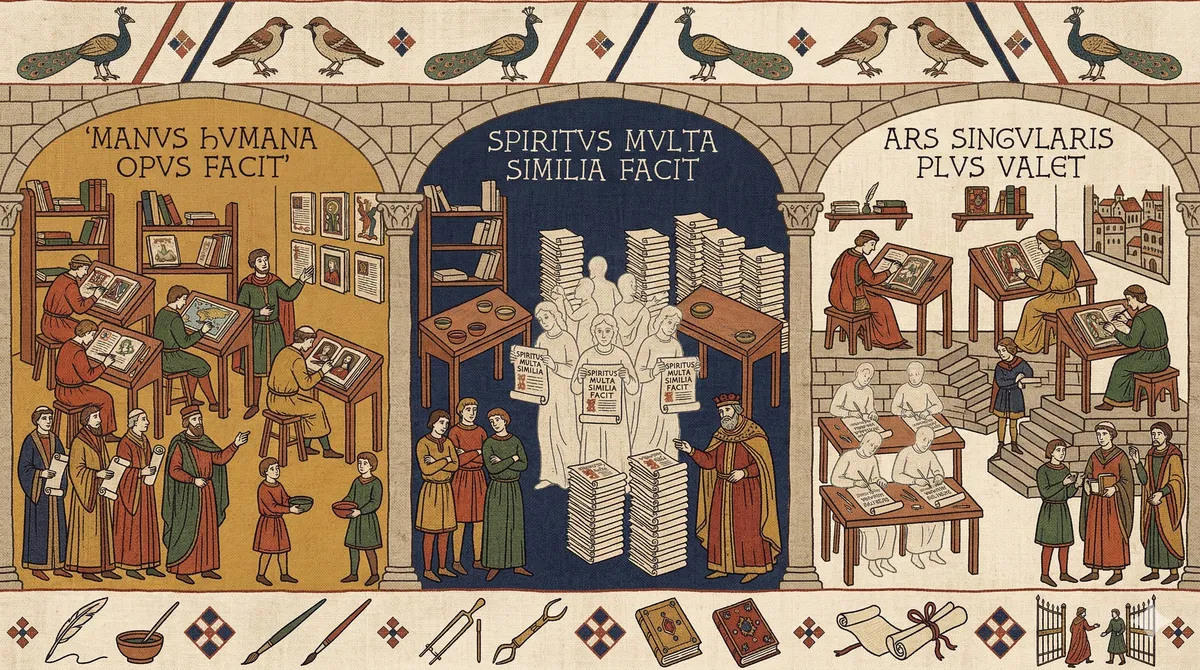
The creative professionals building position right now are doing something the noise around AI makes harder to see. They are treating the expansion of AI-generated content not as a threat to their practice, but as the structural condition that makes their practice more valuable. They understand what happens to a market when a resource becomes cheaper.
That understanding has a name. Jevons’ Paradox. And when you apply it to creative work carefully, the picture it produces is not the one dominating most conversations about authors, illustrators, and the future of the profession.
This sector has survived every major disruption - photography, desktop publishing, digital music, the internet - and grown after each one.
What History Actually Shows
In 1839, photography arrived. The expectation was that portrait painters would lose their livelihoods as cheaper, faster image-making became available to anyone. What happened instead was more interesting. Freed from the obligation to record faithfully, painting became more interpretive, more distinctive, more deliberately authored. The total market for visual art expanded as photography raised awareness of what only a painter could offer. Demand for the high-craft, high-meaning end of visual work grew alongside the cheaper photographic alternative.
In 1985, desktop publishing arrived. The expectation was that graphic designers would be displaced as layout tools became accessible to non-specialists. What happened: the cost of producing designed content fell, which meant organisations that had never before been able to commission design work began doing so, which meant the profession grew substantially over the following two decades. The designers who flourished were those who made strategic visual decisions that a template could not replicate.
In the early 2000s, digital music production tools arrived. The expectation was that session musicians would be automated out of existence by synthesisers and sample libraries. Total music production volume increased substantially as the cost to record fell. Live performance, the thing only a human musician can do in real time, grew into a larger share of the industry’s economics than it had been before.
The pattern is consistent across 180 years of creative disruption. Each technology that made a form of creative production cheaper eliminated the commodity layer of that market and expanded the total market for authored, distinctively human creative work. Not immediately. And not without genuine disruption for those whose income depended on the commodity layer. But structurally, as a direction of travel, the evidence is clear.
1839 - Photography
Prediction: Portrait painters lose their livelihoods.
Result: Painting became more interpretive and distinctive. The total market for visual art expanded.
1985 - Desktop Publishing
Prediction: Graphic designers displaced by accessible tools.
Result: Organisations that never commissioned design began doing so. The profession grew substantially.
2000s - Digital Music
Prediction: Session musicians automated out by synthesisers.
Result: Total music production volume increased. Live performance grew into a larger share of industry economics.
The Mechanism: Why This Happens
William Stanley Jevons observed in 1865 that making coal cheaper to use did not reduce coal consumption; it expanded it, because the lower cost unlocked demand that had previously been suppressed by price. When you make a resource cheaper, total demand for that resource tends to increase, because latent appetite that was previously unaffordable gets unlocked.
For creative work, the mechanism works like this. AI tools lower the cost of producing commodity content. Publishers, game studios, educational organisations, and advertising agencies can now commission more content overall, because the supporting material that previously consumed budget is cheaper to produce. That freed budget does not disappear. It becomes available for the commissioned work that AI cannot replicate: the original authored novel, the illustrator whose visual language is inseparable from the world they are building, the translator who carries cultural register across languages rather than just words.
Consider the educational publisher who currently commissions four illustrators for a curriculum series because that is what the budget allows. As AI handles the routine visual generation in the project, the same budget can reach further. The creative brief expands. The number of artists involved increases. The work that gets commissioned is the work that required a human hand all along.
This is not speculation. It is the Jevons mechanism, operating in a sector where latent demand for authored creative work has always existed and has always been constrained by the cost of the surrounding production infrastructure.
-
Cost drops. AI tools lower the cost of producing commodity creative content.
-
Budget unlocks. Organisations that previously could not afford creative work now can. Existing budgets stretch further.
-
Total demand expands. More creative work is commissioned overall, not less.
-
Authored work benefits. The freed budget flows toward the work AI cannot replicate - distinctive voice, original perspective, craft built over years.
The Distinction That Shapes Everything
The creative market is not a single market. It contains two distinct territories with different demand dynamics, and understanding the difference is what separates the creative professionals building position from those watching from the sidelines.
Commodity Territory
Stock images, generic web copy, functional infographics, templated marketing content.
Direction: Contracting. Under structural pressure since the mid-2010s. AI accelerates an existing trend.
Authored Territory
Distinct voice, original perspective, craft built over years, audience relationships that carry meaning.
Direction: Expanding. The Jevons mechanism operates here. This is where freed budget flows.
The first territory is commodity creative output: stock images, generic web copy, functional infographics, templated marketing content. This territory has been under structural pressure since the mid-2010s, when platforms industrialised visual content and content production at scale. AI accelerates an existing trend here rather than creating a new one. Clients in this space were already optimising on cost. AI resets the cost floor further.
The second territory is authored creative work: a distinct voice, an original perspective, craft built over years, a relationship between creator and audience that carries meaning independent of the specific subject matter. This is the territory where an illustrator’s visual language for a children’s book series is not interchangeable with a generated alternative, where a novelist’s particular way of inhabiting a character cannot be approximated by a model trained on similar fiction, where the translator’s understanding of cultural register produces something qualitatively different from machine translation reviewed by a junior editor.
The Jevons expansion operates in the second territory. And the creative professionals who understand this are actively investing in the qualities that make their work sit there: the specificity of their voice, the depth of their audience relationship, the craft that takes years of practice to develop and cannot be manufactured by a prompt.
What the Creative Professionals Getting Ahead of This Are Doing
The illustrator building position now is developing a visual language distinctive enough that a commissioner recognises it as theirs before they see the signature. They are not competing on speed of delivery. They are investing in the quality of audience relationship that makes their commissions relationship-driven rather than commodity-priced. And they are using AI tools for the pre-production work that previously consumed creative time: rough spatial concepts, reference gathering, colour palette exploration. The freed time goes into the work that distinguishes them.
The author building position now is doing two things simultaneously. First, developing the kind of readership that follows them as an author, not just a subject-matter provider. Readers who buy the book because it is that author’s book, not because the topic is available. Second, understanding which parts of their practice AI handles competently so they can redirect their energy toward the parts it cannot: the structural intelligence of a well-constructed narrative, the voice that is recognisably singular, the thematic depth that requires genuine perspective to generate.
Both of these positions share the same underlying logic: the Jevons expansion increases total demand for creative work, and the creative professionals positioned for that expansion are those who have made themselves irreplaceable rather than merely efficient.
Disruption Underway
There is near-term disruption in this market, and it is real. The commodity territory is contracting at speed. The Society of Authors reported in January 2026 that a significant proportion of their membership has seen earnings reduce and opportunities contract. Those numbers describe the commodity contraction in progress. They are not the structural endpoint. They are the disruption phase that precedes the expansion.
The copyright and governance conversations happening in parallel matter here, and not only as a fairness argument. If AI tools have been trained on creative work without consent or compensation, that is both an ethical failure and a supply chain problem for the industry. An industry that does not sustain early-career creative practice thins its own talent pipeline, and the authored creative work that the Jevons expansion generates demand for requires people capable of producing it. The governance conversation is also a pipeline conversation.
Both of those things are true. And the strategic direction for a creative professional is the same regardless of how the governance picture resolves: invest in the dimension of your work that resists replication, build the audience relationship that makes your work relationship-driven rather than commodity-priced, and use the tools available to redirect your time toward what only you can do.
Honest caveat. The Jevons Paradox does not promise that everything will be fine. Near-term disruption is real. The commodity layer is contracting at speed, and creative professionals whose income depends on that layer face genuine hardship right now.
The Pipeline Risk
An industry that does not sustain early-career creative practice thins its own talent pipeline. The authored work the Jevons expansion generates demand for requires people capable of producing it. The governance conversation is also a pipeline conversation.
6-12 Months from Now
The creative professionals who look back on this period with clarity will have made a specific distinction. They will have separated the contraction of the commodity layer from the structural direction of the total market. They will have invested in their practice at precisely the point when the noise suggested retreat.
In six months, the gap between authored creative work and AI-generated content will be more visible to commissioners, not less. The clients who experimented with AI for core creative work will have learned what it cannot do. The market for the distinctively human, craft-built, singular creative work will be clearer in outline than it is today.
The Jevons Paradox does not promise that everything will be fine. It makes the structural argument that making creative production cheaper tends to expand total demand for creative work, and that the creators best positioned for that expansion are the ones who have made themselves irreplaceable. Which, when you think about it, has always been the argument for developing craft seriously.
Worth considering whether the work you are building toward is the work the expansion creates demand for.
Related reading: More Work, Fewer Doors explores the same Jevons mechanism in technical roles and what it means for talent pipeline strategy. The AI Content Factory and the Artisanal Press examines the bifurcation between mass-produced and craft creative work. From My Grandmother’s Workshop to Publishing’s Future traces the enduring value of artisanal creative practice.