
Nobody watches robot archery
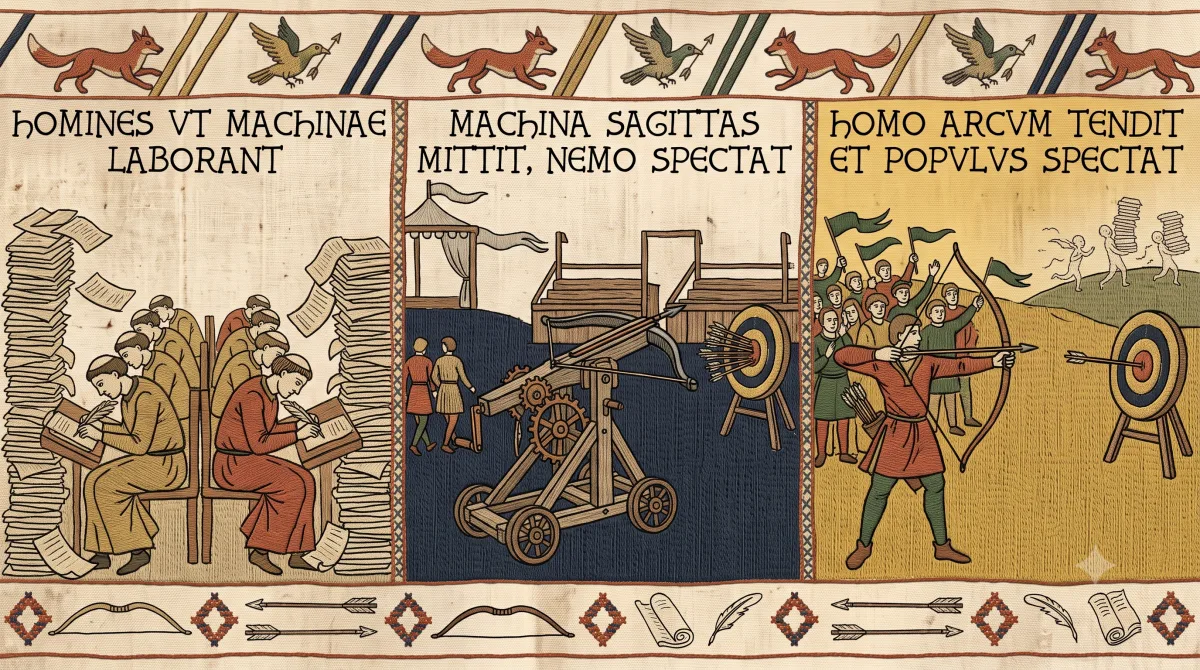
An archer’s job is to be a robot.
Draw, anchor, loose. The same movement, thousands of times, adjusted only for wind and distance. Golf is the same discipline in different trousers: one swing, repeated flawlessly for the circumstances at hand.
Which puts a wrinkle in something I wrote recently, that value is migrating to work that visibly carries human fingerprints. Sometimes we really do want to be robots. Whole sports, whole crafts, are built on nothing else.
And yet. A machine can already out-shoot any archer alive. Mount a camera and an actuator on a rail and it will find the gold every time, in any wind, and nobody would cross the road to watch it.
The perfection was never the point. The point is a human nervous system, with its tremor and its nerves and its bad night’s sleep, mastering itself in public. Difficulty is only interesting when it belongs to someone.
The same instinct explains something every artisan business worked out long before AI arrived. Think of the workshop tour: they walk you through the whole process, raw timber at one end, finished sculpture at the other, and you watch the turner’s hands do the same practised movement they have done ten thousand times. Now try to name anyone who took that tour and left the souvenir shop empty-handed.
The craft is repeatable, close to robotic. You buy the piece anyway, because you saw the hours in it. What you actually paid for was witnessed attention.
Marketing has caught up with the woodturners. The push toward community-building and behind-the-scenes content, showing the team at work rather than just the finished product, is the workshop tour at scale. Publishing knows this too, and it is splitting the industry in two: readers who watch an author speak for an hour will queue to buy the hardback they could have ordered cheaper from their phone in the same room.
So the dividing line between human work and machine work is not perfection versus imperfection. Machines should take the repetition nobody was ever watching, the reconciliations and the re-keying of data between systems that refuse to talk to each other, the thousand invisible loops that fill a working week. Humans keep the repetition that rewards an audience, or the person doing it.
That is a genuinely useful sorting question for any organisation deciding what to automate. Not “can a machine do this to the same standard,” because increasingly it can. Rather two questions: does anyone value watching a human do this, and does the human doing it want to keep it?
If both answers are no, hand it over gladly. If either answer is yes, that repetition is not a cost to be engineered away. It is the product, or the point.
The archer gets to keep the gold. The rest of us get to keep the work we love, and hand over the work we never did.